A blog dedicated to teaching you about food and cooking. Learn to cook. Have fun and Eat well too!
Showing posts with label onions. Show all posts
Friday, August 8, 2014
Sausage and Vegetable Stew
I recently visited Chicago to take in a baseball game at the oldest major league ballpark: Wrigley Field. The food there is very old-school. Unlike my local ballpark Coors Field, the fare is as traditional as...well...baseball! Classic Chicago hot dogs and one of my favorites, sausage and peppers and onions on a roll. This inspired me to create this stew. There's a little bit of sausage but the bulk of it is veggies from my garden - some eggplant, zucchini, and Italian peppers. You can serve this on a hoagie roll or Italian bread. Or you can serve it over rice, like my dinner in the photo. We also ate it stuffed into a pita, though that's a pretty messy container!
You can choose the type of sausage you like best: spicy or mild, chicken or pork. You want a flavorful Italian sausage because the flavors in the sausage provide a lot of flavor in the stew.
Sausage and Vegetable Stew
(serves 6)
1 large sweet onion, sliced
2 Italian sweet peppers, cored and sliced crosswise
4 cloves of garlic, sliced
2 Tablespoons olive oil + ½ Tablespoon
¾ pound Italian sausage, cut into bite-sized pieces
1 14-oz. can diced tomatoes, undrained
1 14-oz. can crushed tomatoes
1 pound zucchini, cut into ½" dice
½ pound eggplant, peeled and cut into ½" dice
salt and pepper
healthy pinch of crushed red pepper (optional)
about 20 large fresh basil leaves, chopped
¼ cup grated Parmesan or Romano cheese
Heat up a large skillet with a lid over medium heat. Add the 2 Tablespoons oil and the onions. Sprinkle with about ¼ teaspoon salt. Cook until golden and very soft, about 20 minutes. After 10 minutes of cooking, lower heat to medium-low to keep the onions from burning. Stir occasionally. This step takes time but this is how you get delicious onions. Add the peppers and garlic. Stir to mix and cook for 10 more minutes, stirring occasionally. Remove the onion mixture to a bowl and set aside.
Return the skillet to the stove and turn up the heat to medium-high. Add the ½ Tablespoon oil. When the oil starts to shimmer, add the sausage. Brown the sausage. Add the diced and crushed tomatoes, scrapping up any brown bits stuck to the bottom of the pan (this is the good stuff!). Add the zucchini, eggplant, ½ teaspoon salt, ½ teaspoon black pepper, and crushed red pepper, if you want a spicy sauce. Stir to mix and cover. Cook for 10 minutes. Remove the cover, add the cheese, and cook for another 5 minutes to thicken the sauce a bit. Stir in ½ the chopped basil. Taste and add more salt and black pepper, if needed. To serve, mound onto a roll, and garnish with onions and remaining chopped basil.
Friday, January 24, 2014
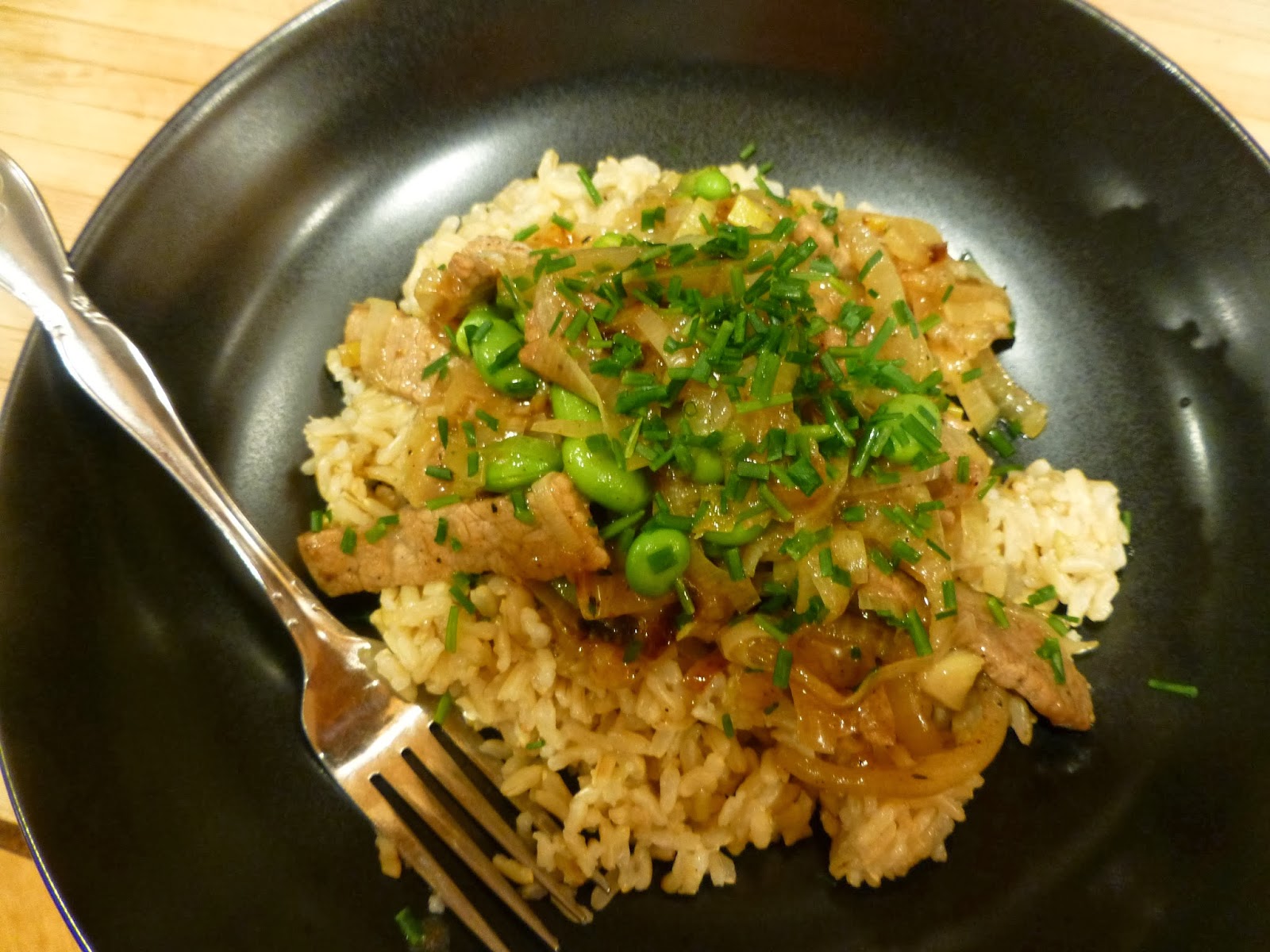
Beef and Onion Stir Fry
Here's a stir fry that proves that you don't have to use Asian flavors to make a stir fry. Stir fry is a technique. Though usually associated with Chinese cuisine, who says it always has to include garlic-ginger-soy sauce in the ingredient list?
I didn't feel like Asian but I had thinly sliced beef and leeks. Huh, that sounds kind of French. OK, let's see how this turns out. Not bad!
I used eye of round that was sliced in the supermarket. Eye of round is It's not really expensive nor really cheap. The recipe only uses half a pound, so the total price stays moderate. But, you get some good beefy flavor. I added shelled soybeans (now available in the frozen food case in many supermarkets) to make up for the small portion of beef. You can use frozen green peas, which are definitely more French than soybeans. Also not French is the thickener. I use a cornstarch slurry.
Leeks can hide a lot of sand in their layers. The best way to clean them is to cut off the root end, cut off the long dark green leaves, then slice them lengthwise, and put them in a bowl of cold water. After a few minutes of soaking, swish them around a bit and rub out any dirt hiding between the layers. Then you are ready to slice them.
Beef and Onion Stir Fry
(serves 4, costs $5.50)
2 medium leeks, white and light green parts, sliced
1 medium onion, sliced
3 Tablespoons vegetable oil
1 ½ cups shelled soybeans, thawed if frozen
½ pound eye of round, sliced thinly and cut into 1" wide strips
salt and pepper
2 teaspoons cornstarch for sprinkling on beef
2 teaspoons cornstarch dissolved in 1 Tablespoon cold water
½ teaspoon dried thyme leaves, crushed
1 cup low sodium beef broth
minced chives or minced parsley, for garnish
Heat up 1 Tablespoon of oil in a large skillet or wok over medium-high heat. Add leeks and onions. Stir-fry until onions are soft and brown on the edges. Stir often to keep them from burning. Add soybeans and cook for another minute. Season with salt and pepper and remove to a bowl. Sprinkle beef with salt, pepper, and 2 teaspoons cornstarch. Wipe out the wok, and add remaining oil. Heat until smoking hot. Add beef and stir fry until browned, only takes a couple of minutes. Remove beef, leaving behind the oil, to bowl with onions. Pour off most of the oil from the wok. Return the wok to medium-high heat. Add beef broth and crushed thyme. Stir to loosen any bits sticking to the bottom of the wok. Add back onions, soybeans, and beef. Stir in cornstarch/water slurry and cook until slightly thickened. Season with salt and pepper - if using regular beef broth, taste it first. You may not need any salt. Serve with rice or noodles and garnish with fresh chives or parsley, if desired.
Saturday, July 6, 2013
What's in season now: Sweet Onions
![]() |
| Sweet onion with baseball for size comparison. And, as sweet onions go, this one is not very big. |
- They are all sweeter than your average yellow onion, which is not to say they won't make your eyes water when you chop them! But, the additional sweetness makes them milder and a great raw onion slice on a burger.
- They are big, sometimes very large.
- They are juicier than yellow storage onions.
- They don't keep well.
That last point is the most important thing to keep in mind when buying sweet onions. Unlike yellow onions, which are grown to be stored for months through the winter, sweet onions will get moldy and mushy in short order. Don't buy more than you can use in a week or so.
The shrimp and white beans with pasta recipe I posted recently is great with sweet onions. French onion soup is delicious made with sweet onions, though I rarely make it with sweet onions. French onion soup is a winter dish for me and there are no sweet onions around in the winter. But, if there is a little chill in the air (or you just have the A/C cranked way up), here's a magnificent version. It's not hard, but it does take a long, long time to cook. It also makes a lot of soup, but you can freeze it. Or have a French onion soup party, since this is definitely a treat. All you need to make a complete meal is a simple green salad and fresh fruit for dessert. Very French!
This recipe uses a roux, a mixture of a fat (in this case oil) and flour, to thicken the soup. A roux is a common thickener in French cooking and it is used frequently in Cajun and Creole cooking. Very dark roux, used in gumbo or Étouffée, is sometimes referred to as Cajun Napalm because this stuff will hurt if you get it on your skin. You don't need to go that far in this recipe, but I felt you needed to know that there is something edible called Cajun Napalm. :-)
French Onion Soup
(serves 10)
¼ cup flour
¼ cup vegetable oil
1 stick of butter
4-5 large onions, sliced (about 10 cups)
1 ½ teaspoons sweet paprika
¾ teaspoon celery salt
¼ teaspoon salt
¼ teaspoon black pepper
10 cups beef stock
1 cup dark beer
½ cup dry red wine
10 1" thick slices French bread
10 oz. Swiss or Gruyère cheese, sliced or coarsely grated
Heat oil in a large heavy dutch oven or soup pot over medium heat. Add flour. Stir constantly to keep it from burning and cook for about 10 minutes. Remove the roux to a small bowl. Return the pot to the stove and medium heat. Add the onions and sauté them, stirring often, until golden yellow. Add paprika, roux, celery salt, salt, pepper, and beef stock. Stir well. Reduce heat to low and cook for 4 to 6 hours (yes, that long!).
Add beer(if using) and wine and simmer while you toast the bread slices. Heat the oven until very hot, 450°F. Toast the bread in the oven until golden brown. To finish soup, ladle into large soup bowls. Add a slice of bread, sprinkle a scant ¼ cup of grated cheese or 1 slice over the bread slice and place the bowls on a baking sheet. They are easier to put in and take out of the oven this way. Place the soup in the hot oven and bake until the cheese is melted and gooey. Serve immediately but be careful! The soup under the cheese is burn-your-tastebuds-off hot.
To freeze, freeze only the soup. Reheat to a simmer then proceed with heating the oven and toasting the bread.
Note: I have not tried this recipe in a slow cooker, but I bet it would work there too. You still need to make the roux and sauté the onions on the stove, though. If you dump the raw onions and the stock into the slow cooker, the onions never get that wonderful soft texture that comes from sautéing them first.
This recipe uses a roux, a mixture of a fat (in this case oil) and flour, to thicken the soup. A roux is a common thickener in French cooking and it is used frequently in Cajun and Creole cooking. Very dark roux, used in gumbo or Étouffée, is sometimes referred to as Cajun Napalm because this stuff will hurt if you get it on your skin. You don't need to go that far in this recipe, but I felt you needed to know that there is something edible called Cajun Napalm. :-)
French Onion Soup
(serves 10)
¼ cup flour
¼ cup vegetable oil
1 stick of butter
4-5 large onions, sliced (about 10 cups)
1 ½ teaspoons sweet paprika
¾ teaspoon celery salt
¼ teaspoon salt
¼ teaspoon black pepper
10 cups beef stock
1 cup dark beer
½ cup dry red wine
10 1" thick slices French bread
10 oz. Swiss or Gruyère cheese, sliced or coarsely grated
Heat oil in a large heavy dutch oven or soup pot over medium heat. Add flour. Stir constantly to keep it from burning and cook for about 10 minutes. Remove the roux to a small bowl. Return the pot to the stove and medium heat. Add the onions and sauté them, stirring often, until golden yellow. Add paprika, roux, celery salt, salt, pepper, and beef stock. Stir well. Reduce heat to low and cook for 4 to 6 hours (yes, that long!).
Add beer(if using) and wine and simmer while you toast the bread slices. Heat the oven until very hot, 450°F. Toast the bread in the oven until golden brown. To finish soup, ladle into large soup bowls. Add a slice of bread, sprinkle a scant ¼ cup of grated cheese or 1 slice over the bread slice and place the bowls on a baking sheet. They are easier to put in and take out of the oven this way. Place the soup in the hot oven and bake until the cheese is melted and gooey. Serve immediately but be careful! The soup under the cheese is burn-your-tastebuds-off hot.
To freeze, freeze only the soup. Reheat to a simmer then proceed with heating the oven and toasting the bread.
Note: I have not tried this recipe in a slow cooker, but I bet it would work there too. You still need to make the roux and sauté the onions on the stove, though. If you dump the raw onions and the stock into the slow cooker, the onions never get that wonderful soft texture that comes from sautéing them first.
Tuesday, December 18, 2012
What's in Season now?
Winter is setting in but that doesn't mean all the good produce deals are gone. A number of fruits and vegetables are not only at their prime right now, but fairly inexpensive.
Citrus: There was a reason people were excited to find oranges in their Christmas stocking once upon a time. Winter is citrus season in the warmer parts of the Northern Hemisphere and they were still hard to get in cold places until well into the 20th century. Nowadays, there is a bumper crop of any number of delicious and nutritious citrus in US supermarkets. There are navel oranges, grapefruits, satsumas and clementines. Great for eating out of hand or using in recipes.
![]() |
| Kabocha squash from my garden. A delicious Japanese variety. |
Winter Squash: We wrote about winter squash back in October. It's still out there. Winter squash is a great keeper but when this year's crop is gone, the price will jump.
Spinach: Spinach thrives in cooler temperatures. As any gardener can tell you, it bolts (goes to seed) with the slightest hint of hot weather. Frozen spinach is cheap throughout the year, but the flavor of fresh spinach is far better. Baby spinach is available year-round too but it is usually three to four times as expensive as fresh bunch spinach. Like other fresh greens, spinach needs thorough cleaning. A lot of sand can hide in those leaves. For tips on cleaning it, see our post on kale. This recipe from a recent class calls for baby spinach, but fresh spinach works just as well if you coarsely chop it.
Onions: Aren't onions in season all the time? Yes, you can get onions year-round and they are usually inexpensive. But, they are harvested in the summer, then stored. They are quite sensitive to raising temperatures (not a problem in commercial storage) so as we move out of winter into spring, they start to sprout and get soft soon after showing up in the supermarkets. This time of year, that's not a problem as temperatures remain low.
Here's a recipe that uses lots of onions: a slow cooker pot roast. Many recipes call for dumping everything in the slow cooker and letting is cook for a long, long time. If you do this, the onions will never get meltingly tender. They will stay crunchy even after hours of cooking. You are certainly welcome to cook it that way but it's much better if you take the time to saute the onions in a bit of oil before dumping it in the slow cooker. Yes, yes, another step, but well worth it.
As with most stews and braises, this recipe is even better chilled overnight and reheated. The sauce also freezes well, though don't freeze it with the pasta. Pasta doesn't freeze well.
Italian Pot Roast with Onion Sauce
(serves 8, cost $14.30*)
1 2-pound piece of beef top round, arm roast, or chuck roast
2 Tablespoons vegetable oil or olive oil
4 large onions, thinly sliced
1 carrot, finely chopped
½ stalk celery, finely chopped
2 Tablespoons chopped parsley, about 5 large sprigs
1 teaspoon dried sage, crumbled in your palm
10 whole white or black peppercorns
1 cup white wine (alcohol-free is fine)
1 teaspoon salt + a bit more for seasoning meat and onions
1 cup of water
ground black pepper for seasoning meat
2 Tablespoons tomato paste (see Note)
1 pound penne or rigatoni pasta
grated Parmesan cheese, for garnish
Season meat with salt and black pepper. Place in a 3 to 5 quart slow cooker.
Heat oil in a large skillet over medium heat. Add onions, sprinkle with about ⅛ teaspoon salt (a healthy pinch), and cook, stirring often, until onions are golden and translucent. Pour all the onions on top of the meat. Add carrot, celery, parsley, sage, peppercorns, white wine, 1 teaspoon salt, and water to slow cooker. Set slow cooker to cook on low for 7 hours.
After 7 hours, remove the meat. It should be quite tender. Shred it and add back to onions. Stir in 2 Tablespoons tomato paste. Keep covered while cooking pasta.
Cook pasta according to package directions. Serve meat sauce over pasta and garnish with Parmesan cheese, if desired.
Note: Look for tomato paste in a tube. It will keep a long time in the refrigerator, unlike an open can of tomato paste.
*Usually, I use local prices to estimate recipe cost. This time I used the USDA's price average for a boneless choice-grade chuck roast, which is $4.57. That's a national average. In my local supermarket, that cut is selling for $5.49/pound, considerably more. The total cost using local prices is $16.10. Which only points out the difficulty of estimating recipe costs. Still, I think it is a useful gauge of costliness of our recipes and will continue to post it.
Adapted from 12 Best Foods Cookbook by Dana Jacobi (Rodale, 2005)
Sunday, January 1, 2012
Vegetarian Lentil Soup
Homemade soup is so easy, so filling, so inexpensive. Your homemade soup will taste so much better than anything in a can. Why not try to make your own?
Vegetarian Lentil Soup
(serves 4 as a main course; total cost is $4.86)
¼ cup olive oil
2 tablespoons butter
4 cloves garlic, minced
3 large onions, diced
7 ½ cups water
1 cup lentils, rinsed and picked over for stones (see Note)
4 carrots, peeled and thinly sliced
3 celery stalks, thinly sliced
¼ cup tomato paste mixed with ½ cup water
1 tablespoon soy sauce
½ teaspoon salt
black pepper to taste
2 tablespoons chopped parsley
Heat olive oil and butter in a large soup pot over medium heat. Add garlic and onions. Cook for about 10 minutes, until onions are very soft and golden. Stir often to get even browning.
Add everything else except the parsley. Raise the heat to high and bring to a boil. Give it a good stir, reduce heat to a simmer and cook for 45 minutes. The lentils and carrots should be very tender.
Just before serving, stir in the parsley.
Note: Nowadays, it's pretty unusual to find any pebbles in your dried beans, but I have found them so it's best to look.
Vegetarian Lentil Soup
(serves 4 as a main course; total cost is $4.86)
¼ cup olive oil
2 tablespoons butter
4 cloves garlic, minced
3 large onions, diced
7 ½ cups water
1 cup lentils, rinsed and picked over for stones (see Note)
4 carrots, peeled and thinly sliced
3 celery stalks, thinly sliced
¼ cup tomato paste mixed with ½ cup water
1 tablespoon soy sauce
½ teaspoon salt
black pepper to taste
2 tablespoons chopped parsley
Heat olive oil and butter in a large soup pot over medium heat. Add garlic and onions. Cook for about 10 minutes, until onions are very soft and golden. Stir often to get even browning.
Add everything else except the parsley. Raise the heat to high and bring to a boil. Give it a good stir, reduce heat to a simmer and cook for 45 minutes. The lentils and carrots should be very tender.
Just before serving, stir in the parsley.
Note: Nowadays, it's pretty unusual to find any pebbles in your dried beans, but I have found them so it's best to look.
Subscribe to:
Posts (Atom)